
When people used to look for a tool, a service provider or a piece of software, they googled it. Today more and more of them ask ChatGPT, Claude or Gemini instead – and get not a list of ten links but an answer with three or four recommendations. If you are not named there, you do not exist for that question.
For businesses, that is new territory. With Google, you roughly knew how it worked: keywords, rankings, backlinks. With AI assistants it is less transparent. They often search the web themselves before they answer – but what exactly they search for, and which pages they rely on in the end, you cannot see. Generative Engine Optimization, or GEO, therefore starts with a simple question: what actually happens between the question and the answer?
Ask the way your customers would
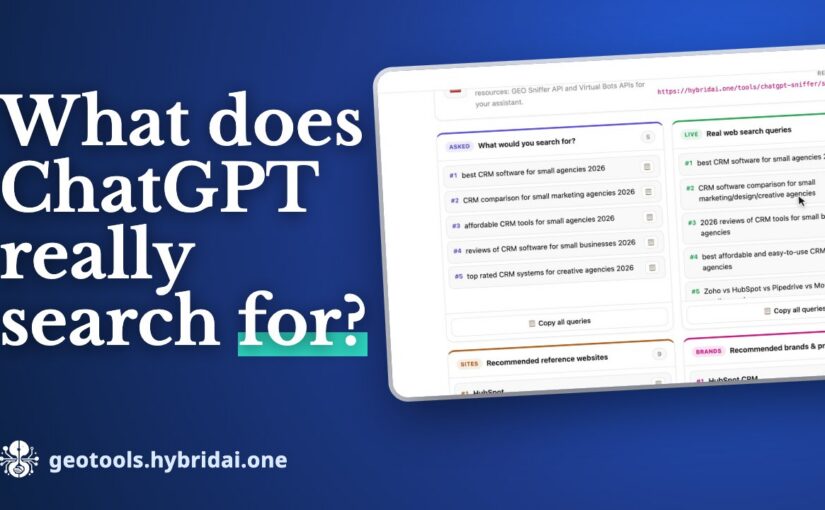
That is where the GEO Sniffer comes in. You pick a model – ChatGPT, Claude or Gemini – and ask a question the way your customers would. In our video, it is: “Which CRM software works best for small agencies?”
The result comes in two columns, and the difference between them is what is really interesting:
- Asked – what the model says it would search for,
- Live – the web searches it actually sends.
The two lists are often similar, but rarely the same. And it is the real searches you need to be found for.
Who the AI recommends – and what it relies on
Below that are the websites the model relies on for its answer and the brands and products it recommends. In our example, those were comparison and review sites on one side and the well-known CRM vendors on the other. The results are live and change a little with every request – just like the answers real users get.
That leads to a very concrete insight: these sources are the places where you need to be present if you want the AI to name you.
From analysis to a GEO strategy
It does not stop at the analysis. From the queries, sources and brands, the GEO Sniffer builds a GEO strategy: the keywords that matter, the platforms where it is easiest to get listed, ideas for content that is still missing, and concrete actions for the coming week.
And because every model searches differently, comparing is worth it: the same question to Claude or Gemini often brings different searches – and different recommendations.
In your own toolbox
You can copy all queries, websites and brands with one click. If you want to use the sniffer regularly, download it as an LLM skill – a ZIP with a SKILL.md and the resources your own AI assistant needs – or integrate it into your own workflows through the REST API.
Try it
Up to 15 requests a day are free: geotools.hybridai.one.