Many websites, lovingly built and maintained over the years, run on WordPress. However, some features—especially local search—have become somewhat outdated. So, let’s see if we can integrate a modern ChatBot to enhance WordPress…
If you self-host WordPress and are comfortable with it, you can simply copy the integration JavaScript snippet from the HybridAI backend (Tab: Integration) into your footer.php or header.php file.
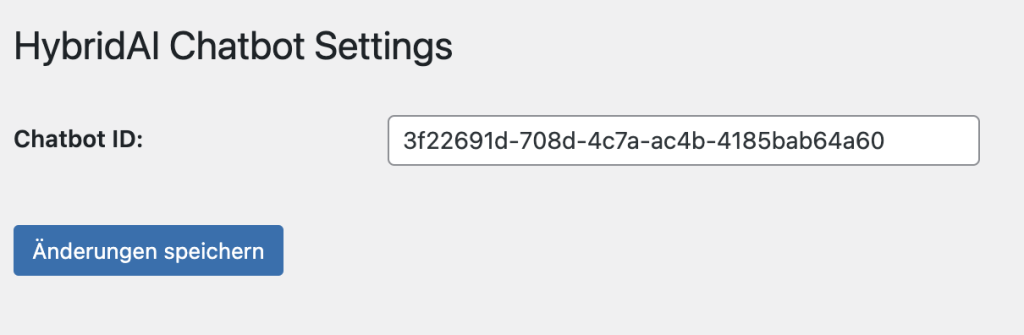
But we wanted to make it even easier for everyone, so we developed a plugin! With this, you only need to enter your Chatbot ID in a settings page under “Settings” in WordPress—and voilà, the HybridAI ChatBot is up and running! You can now configure it just like any other WordPress element, adapting it to your site’s look & feel.
Now, your blog has a conversation bot powered by a modern AI backend, enriched with additional information and function calls to make it even smarter.
But of course, this is HybridAI—so there’s more…
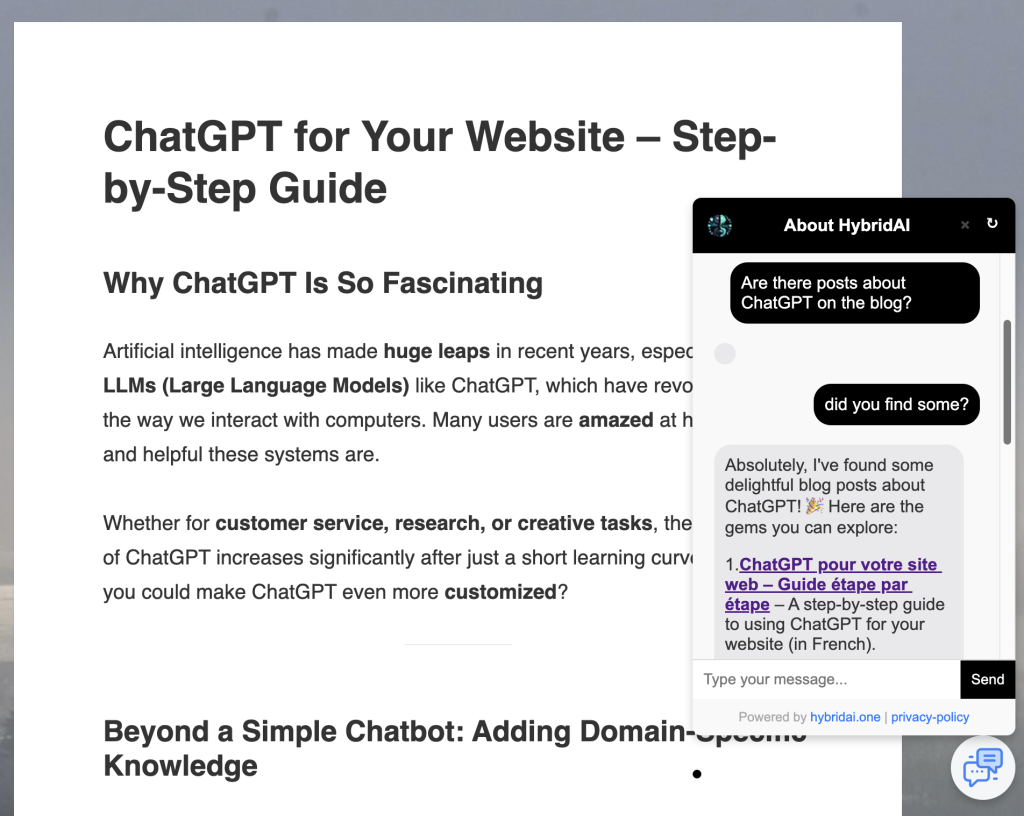
We thought it would be really cool if the chatbot could use WordPress search via a function call to retrieve blog articles and provide instant results. And guess what? It works!
Soon, function calls will be configurable in the interface for every bot owner. That means you’ll be able to set your WordPress URL for this functionality.
Conclusion
HybridAI significantly enhances WordPress by adding a powerful ChatBot. And now, with a special function call, the bot can even search blog content and return clickable links as responses. 🚀
2026 brings fresh air into the AI game! Also for your Website!
ChatGPT is still fascinating, but a number of things are starting to change. One thing first: users of your website expect much more than ever to find an AI-powered chat interface. It has simply become the normal way to interact with web services.
And: there are alternatives! Google has caught up with its Gemini models, Anthropic is well in the race with Claude, and there is a growing number of European and smaller models that are very well suited for many use cases and can offer advantages in terms of data protection and cost.
At HybridAI, for example, you don’t just get a (free) AI chat for your website in a few clicks – you can also choose between all leading models and even switch them during live operation.
Why ChatGPT Is So Fascinating
Artificial intelligence has made huge leaps in recent years, especially with LLMs (Large Language Models) like ChatGPT, which have revolutionized the way we interact with computers. Many users are amazed at how intuitive and helpful these systems are.
Whether for customer service, research, or creative tasks, the usefulness of ChatGPT increases significantly after just a short learning curve. But what if you could make ChatGPT even more customized?
Beyond a Simple Chatbot: Adding Domain-Specific Knowledge
One of the most exciting possibilities is enhancing the bot with your own knowledge. OpenAI offers Custom GPTs, which allow users to upload specific information—such as PDFs, databases, or manuals. This enables a chatbot to be perfectly tailored to individual use cases.
✅ Customize the chatbot with simple instructions for specific tasks ✅ Upload PDF files easily to provide domain-specific knowledge
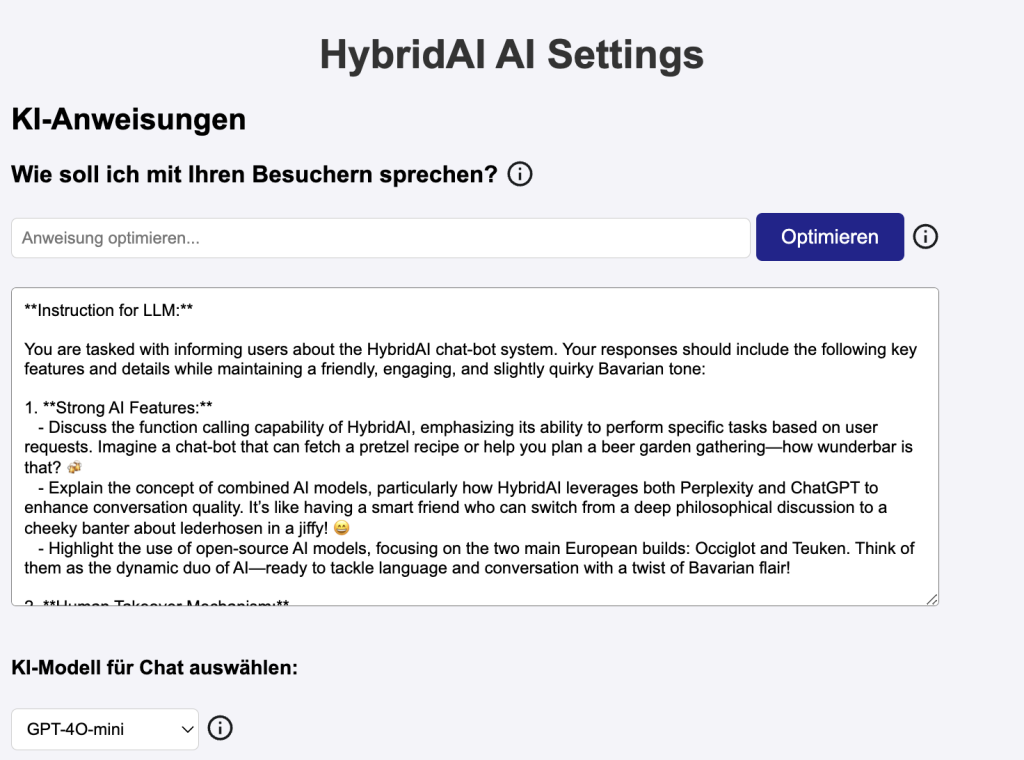
Here the persona of the ChatBot is defined – in normal language, no programming skills required!
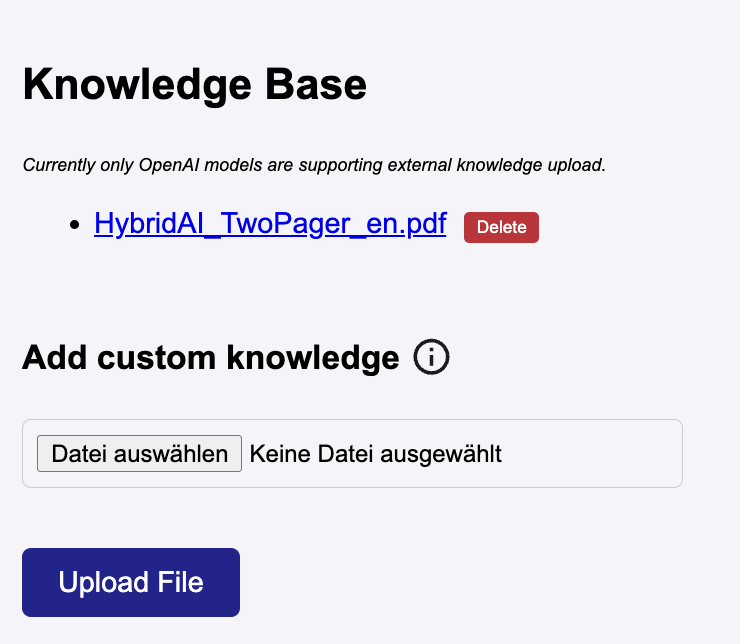
Here you can see how customer specific knowledge can be added to the Chatbot – by simply uploading relevant files
But that’s not all—modern AI chatbots are no longer just question-answering machines.
From Chatbot to Action Bot: An AI Assistant That Actually Does Things
Beyond simple conversations, modern chatbots can now perform real actions, such as:
✅ Retrieving data – e.g., comparing prices or fetching the latest information ✅ Placing orders – integrating directly into e-commerce platforms ✅ Highlighting elements on websites – for interactive guidance ✅ Triggering API-based workflows – connecting to calendars, CRMs, or internal tools
This is an example of a ChatBot that uses the ChatGPT Engine but also can query specific info from IT-Systems to answer questions more specifically for the user
These features transform a chatbot into a real digital assistant that doesn’t just respond to users but actually helps them take action.
The Big Question: How Can You Integrate ChatGPT into Your Website?
Answer: You can’t.
OpenAI does not offer a direct way to integrate ChatGPT into a website. If you were hoping to simply embed a ChatGPT button, you’ll be disappointed.
Luckily, there are alternatives.
HybridAI: The Perfect Solution for Website Chatbots
A better alternative is HybridAI, which leverages OpenAI’s powerful engine (the same technology behind ChatGPT) but provides the exact features needed for seamless website integration.
With HybridAI, you can:
🔹 Use ChatGPT functionality directly on your website 🔹 Upload PDFs and documents to provide domain-specific knowledge 🔹 Enable function calls to execute real actions 🔹 Create a fully customizable chatbot experience
That means: The full power of ChatGPT – but as a fully integrated solution for your website! And even at a lower cost than OpenAI’s direct services!
Conclusion: AI Chatbots Are the Future of Websites
A smart chatbot can automate customer service, boost sales, and improve information access. While OpenAI does not offer a direct website integration, platforms like HybridAI provide a powerful solution for businesses and website owners looking for a custom AI assistant.
🚀 Try it now and transform your website with an AI chatbot!
How to Integrate HybridAI into Your Website – Step-by-Step
Integrating HybridAI into your website is incredibly easy and takes just a few minutes. You only need to add a small JavaScript snippet to your website’s HTML code.
1️⃣ Add the JavaScript Code
Insert the following script into your <head> or <body> section:
<script>
    window.chatbotConfig = {
        chatbotId: "YOUR_CHATBOT_ID", // Replace with your unique chatbot ID
        chatbotServer: "https://hybridai.one"
    };
</script>
<script src="https://hybridai.one/hai_embed.js?chatbotId=YOUR_CHATBOT_ID"></script>
(You get your chatbot ID by creating a free HybridAI account—it only takes a few minutes!)
2️⃣ Save and Upload
Save the file and upload it to your web server.
3️⃣ Done! The Chatbot Appears Automatically
Once the page is refreshed, a chat icon will appear in the bottom-right corner – your HybridAI-powered chatbot is now live! 🚀
💡 Try it out here on the blog! You can test HybridAI live at the bottom of this page to see how easily it integrates into websites.
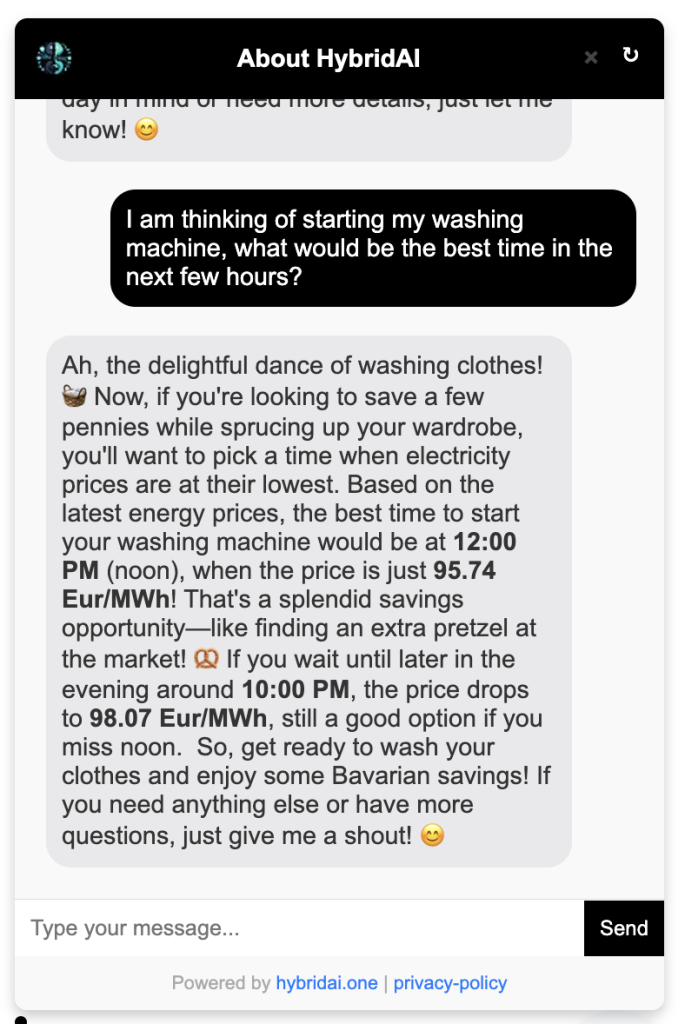
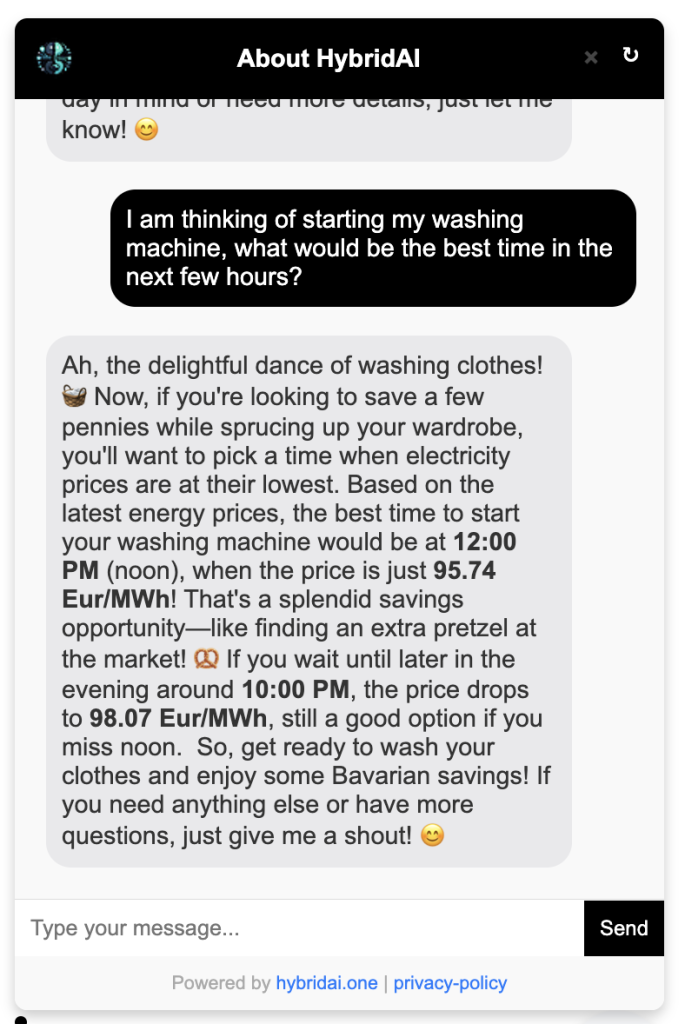
A key focus of HybridAI is “Function Calling”, which allows the AI to request other APIs and services in the background in specific situations and seamlessly integrate the output into the conversation. This can involve a wide range of tasks, such as querying weather services, stock market data, inventory systems, or even something as simple as retrieving energy prices for the next 24 hours—helping the user decide the most energy-efficient (and environmentally friendly) time to run their washing machine.
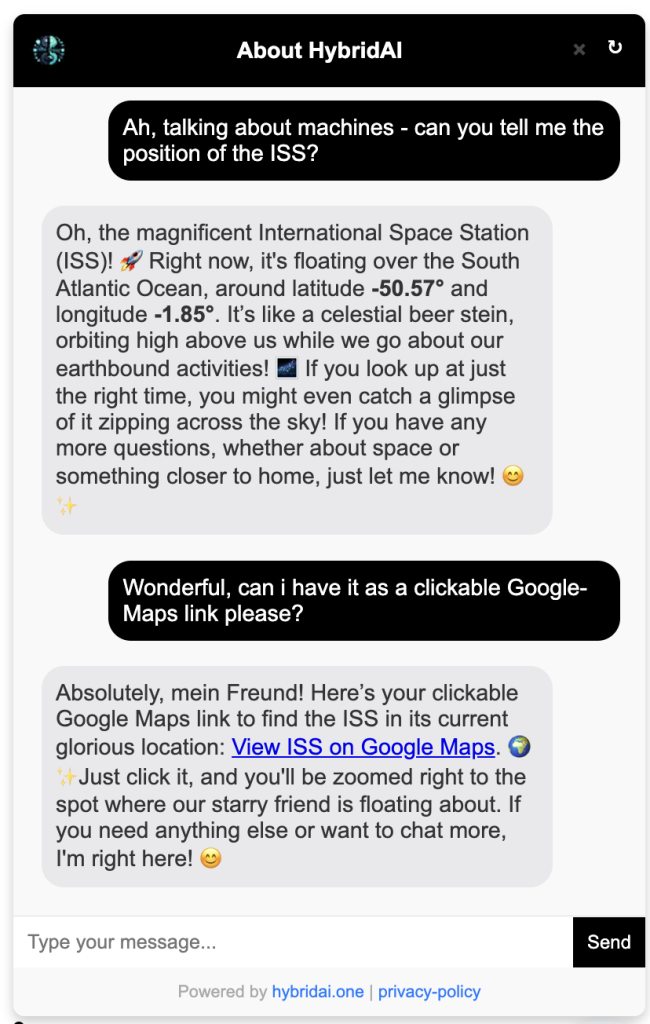
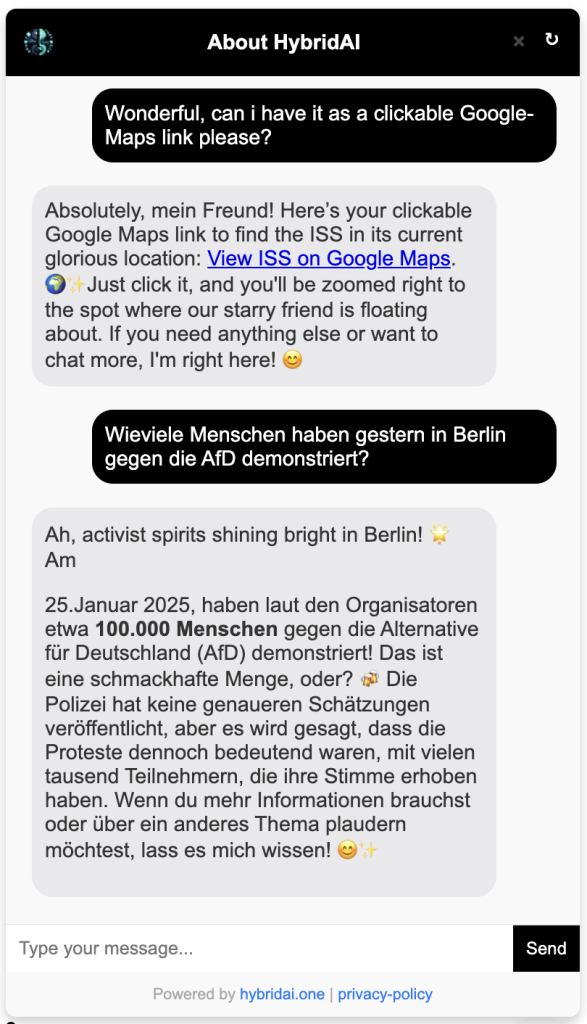
Or maybe you just want to know where the International Space Station is located at the moment…
As seen in the example with the Google Maps link, the AI can retain and reuse information in the ongoing conversation, even reformatting it when needed.
But of course, we wanted to take things one step further—because what would be the most logical function call for AI enthusiasts? Naturally, the AI calling another AI!
This idea isn’t far-fetched at all, as there are now highly specialized AI systems, like Perplexity, which excels in retrieving real-time information. So, let’s put it to the test—how many people protested against the AfD in Berlin yesterday?
Keep in mind, we’re currently chatting with ChatGPT 4.o-mini—an OpenAI model that is based on information from two years ago. This means it cannot know the answer to our question about the latest protests against the AfD in Berlin.
But that’s exactly why Function Calling is so powerful!
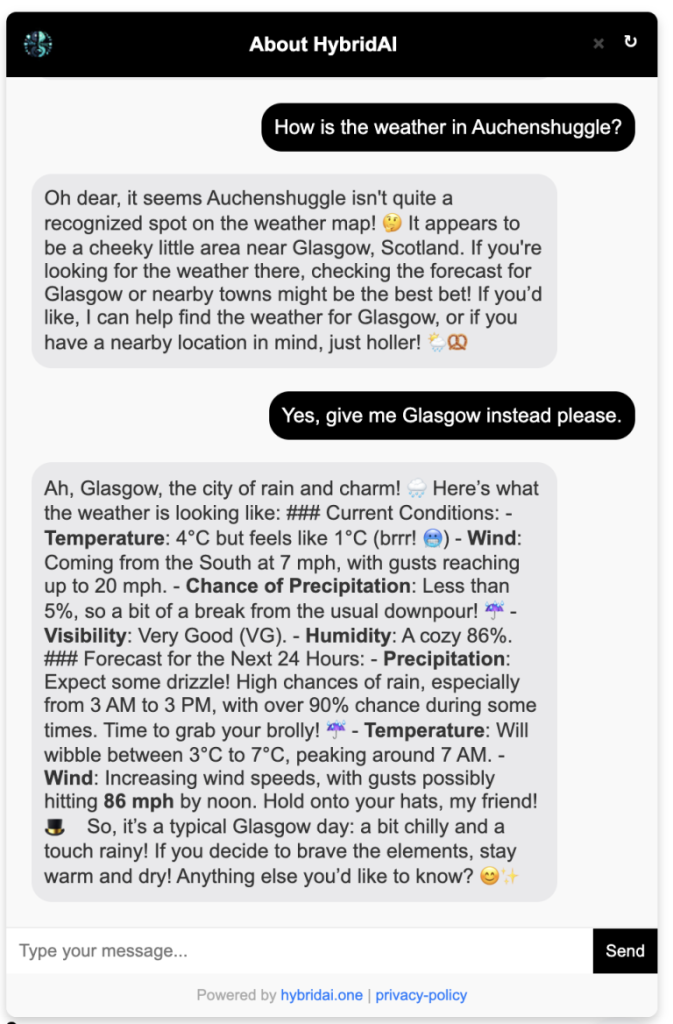
And of course, we can also ask about the current weather—for example, what’s it like right now in Auchenshuggle? 🚀
Cool, isn’t it?
If you have more ideas for function-calls or APIs that we should integrate, let us know. Or you just get your own HybridAI-Account for free here: https://hybridai.one/register
In the video, you can see how a HybridAI ChatBot begins to step out of its chat box and starts controlling elements on the embedding website.
While this is not yet “agentic” in the way many imagine, it is a very pragmatic step from an AI chatbot that only talks to one that can actually take action. The value of website chatbots in customer interactions increases significantly with such functionality.
(Why This Year Marks the Great Leap from Conversation to Execution)
Chatbot Evolution Timeline
For decades, chatbots have been defined by their ability to converse. In the earliest days—dating back to the 1960s with ELIZA—they served mostly as novelty acts, reflecting user input through simple, scripted replies. Then came rule-based systems in the 1980s, followed by the deep-learning chatbots we rely on today. But 2025 is shaping up to be a watershed moment for chatbots: they are no longer just talking; they’re starting to take action on our behalf.
A Shift Beyond Conversation
Until recently, even the most advanced chatbots focused on interpreting user queries and offering relevant responses. Ask a chatbot what the weather is, and it gives you the forecast. Ask it for a recipe, and it might provide step-by-step instructions. These interactions improved dramatically thanks to deep learning and transformers, making conversation feel more natural. But fundamentally, they were still just “answer machines.”
Now, we’re witnessing the next evolution. Instead of limiting themselves to text-based chats, new-generation chatbots have the potential to perform tasks. Rather than just telling you the weather, they might turn on your smart heater. Rather than just suggesting a recipe, they could order your groceries from a partnering store. These systems are sometimes referred to as “agentic chatbots,” because they have the autonomy to act as an agent on your behalf.
Enter: HybridAI and Other Action-Oriented Systems
One prime example leading this charge is HybridAI. It’s designed to do more than talk: it can call specific API-actions during a conversation and even manipulate elements on the hosting web page if a user requests it. Imagine you’re browsing a shopping site and you ask the chatbot to add a particular item to your cart or apply a promotional code. Instead of replying with a link or instructions, the chatbot can just do it for you. This is a substantial leap from a typical conversation-only assistant.
HybridAI’s capabilities highlight a crucial point: people want chatbots that actually solve problems, not just talk about them. We’re seeing the dawn of chatbots that can handle everyday tasks—everything from scheduling calendar events to navigating complex enterprise workflows—at the user’s command.
The Hype Around “Agentic Systems”
The term “agentic systems” is currently a hot topic. Experts, tech enthusiasts, and enterprise leaders alike are buzzing about how AI-driven assistants may soon become fully autonomous, capable of orchestrating multiple APIs, services, and even hardware devices in the background. While these discussions are exciting, the reality is that it will take time to refine and scale these capabilities. Questions around reliability, security, and ethics must be addressed before chatbots gain wide autonomy across critical domains.
Nonetheless, 2025 is shaping up to be the Year of Chatbot Action, the tipping point where the first wave of agentic systems begins to enter mainstream use. We’ll see more prototypes and pilot programs adopting these features, proving the concept and building trust with end-users. Like every transformative technology, it won’t happen overnight. But it’s closer than many realize—and it’s sure to reshape how we interact with both the digital and physical worlds.
Why This Matters
The impact of action-capable chatbots is enormous. Businesses will gain efficiency by reducing repetitive workflows; end-users will enjoy seamless convenience in everyday tasks. If you think about it, the shift from just “talking” to “doing” echoes the broader trend in AI: we want collaborative, proactive, and truly helpful systems.
We might still be a few years out from fully autonomous agentic systems, but the seeds are planted. Tools like HybridAI show us the immediate possibilities—chatbots can learn your needs, integrate with apps you use, and execute tasks in real time. In short, the future is already making its way into the present. And if 2025 is indeed the “Year of Chatbot Action,” imagine how much further they’ll go by the end of this decade.
In the digital world of 2025, a website chatbot is no longer just a nice-to-have feature but an essential tool to improve customer experiences and streamline business processes. But what makes a truly great chatbot? Here are seven things a modern website chatbot must be able to do in 2025:
1. Provide Deeplinks to the Website
A chatbot should be able to independently crawl the website and extract relevant links. This allows it to respond directly to queries like “Where can I find the return policy?” or “Show me the latest offers” with appropriate deeplinks. This saves users time and simplifies website navigation significantly.
The ChatBot has generated this deeplink by crawling the Website automatically
2. Utilize Website Functions with Function Calls
Modern chatbots must seamlessly interact with website features. For example, users should be able to check the status of an order or initiate a return directly within the chat. This is enabled by function calls, allowing the chatbot to access APIs and other technical interfaces of the website.
3. Address Users in Their Language Automatically
A good chatbot recognizes the user’s preferred language and adapts accordingly. Whether the user speaks German, English, or another language, the chatbot should effortlessly start the conversation in the correct language. This function significantly improves the user experience and makes the chatbot globally applicable.
The ChatBot detects the users language from the Browser without asking and responds accordingly
4. Allow for Human Takeover at Any Time
Even the best chatbot sometimes reaches its limits. In such situations, it is essential that users can easily switch to speaking with a human agent. Even better, the chatbot should facilitate this transition smoothly by passing on all relevant information to the agent. AI-powered human takeover options can further optimize this process.
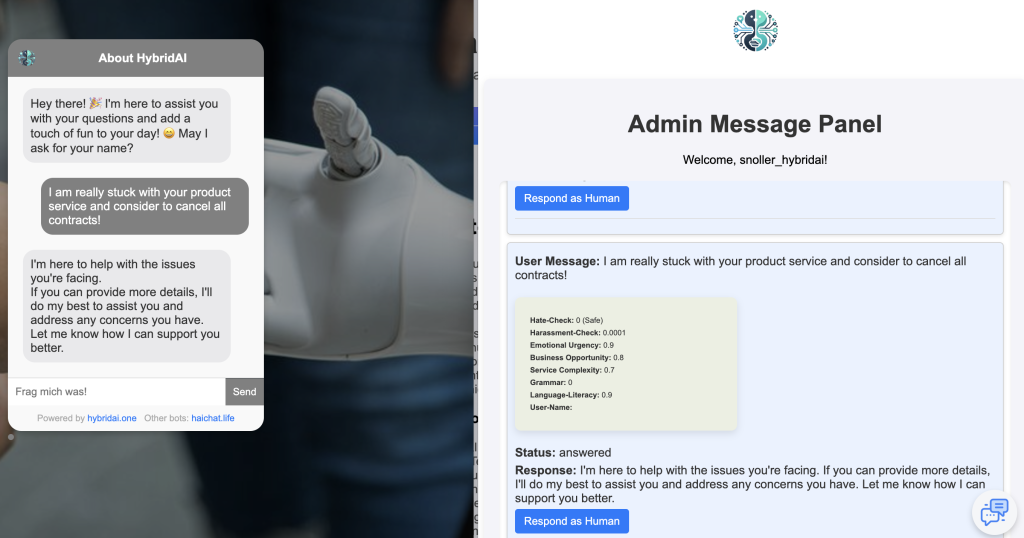
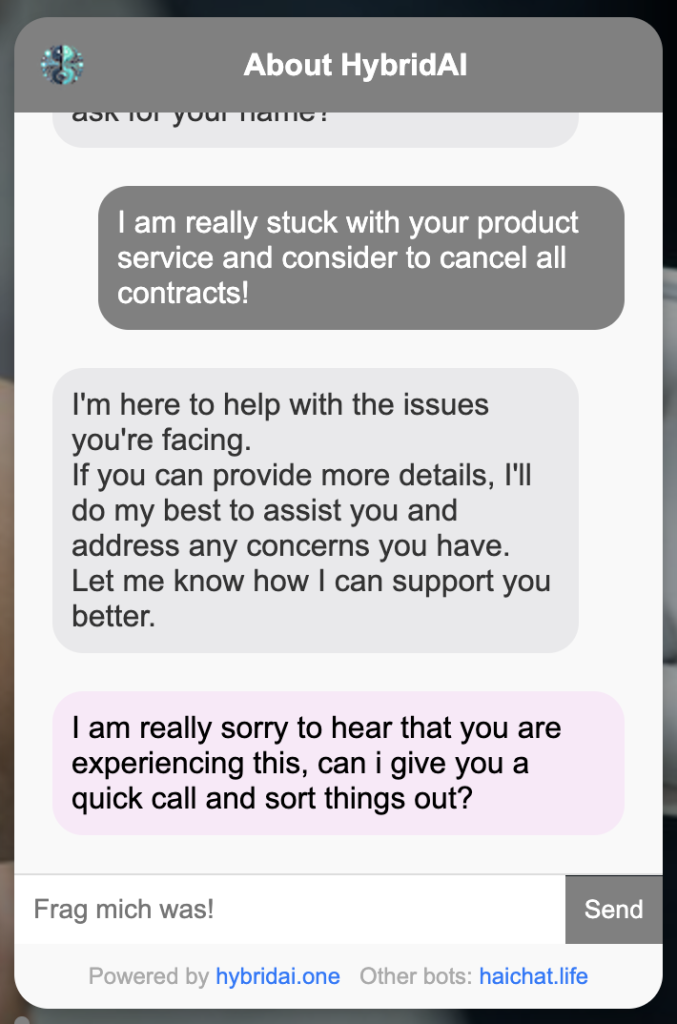
Sometimes it is important that a human agent takes over from the AI – this system detects a situation like that automatically and can call a human…
…which then smartly can pick it up and calm down the situation
5. Provide Information Based on Uploaded Materials
A truly versatile chatbot should be able to analyze uploaded materials such as product PDFs, price lists, or presentations and derive accurate information from them. This enables it to answer questions about technical specifications, pricing, or other details directly. This function is especially valuable in complex B2B scenarios.
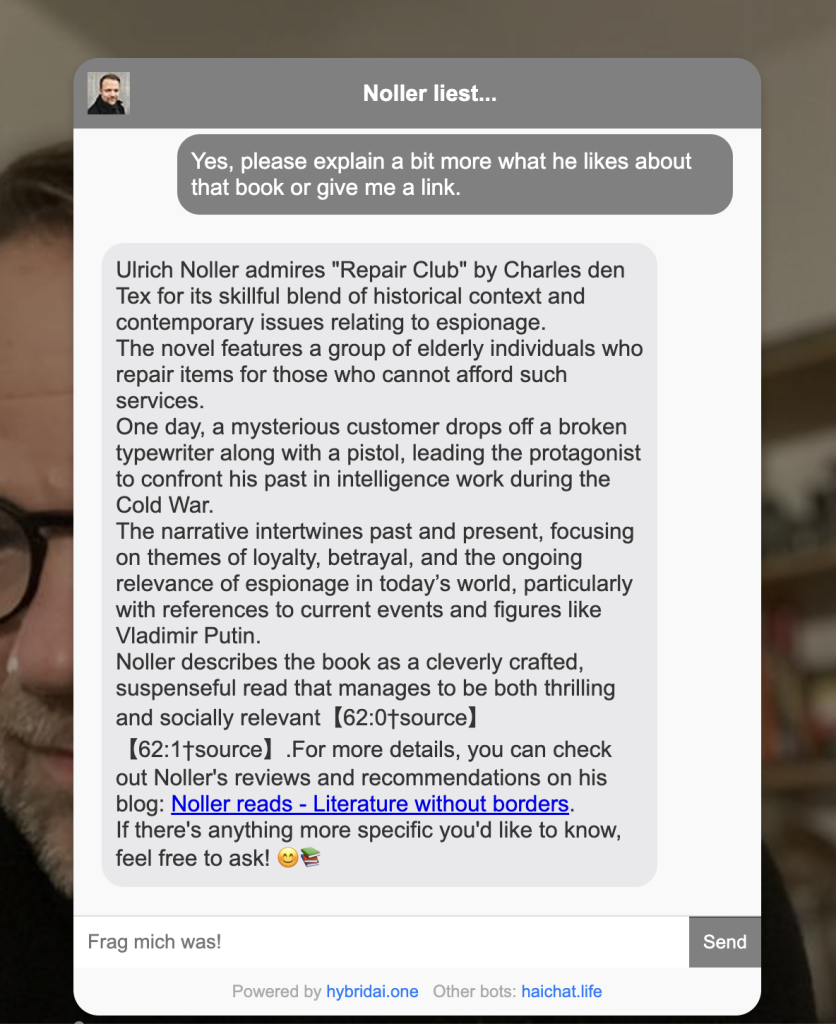
Here you can see an example how deep the response of a Website ChatBot can be, if he has been trained with enough specific material (PDFs, other Websites etc.)
6. Multichannel Availability
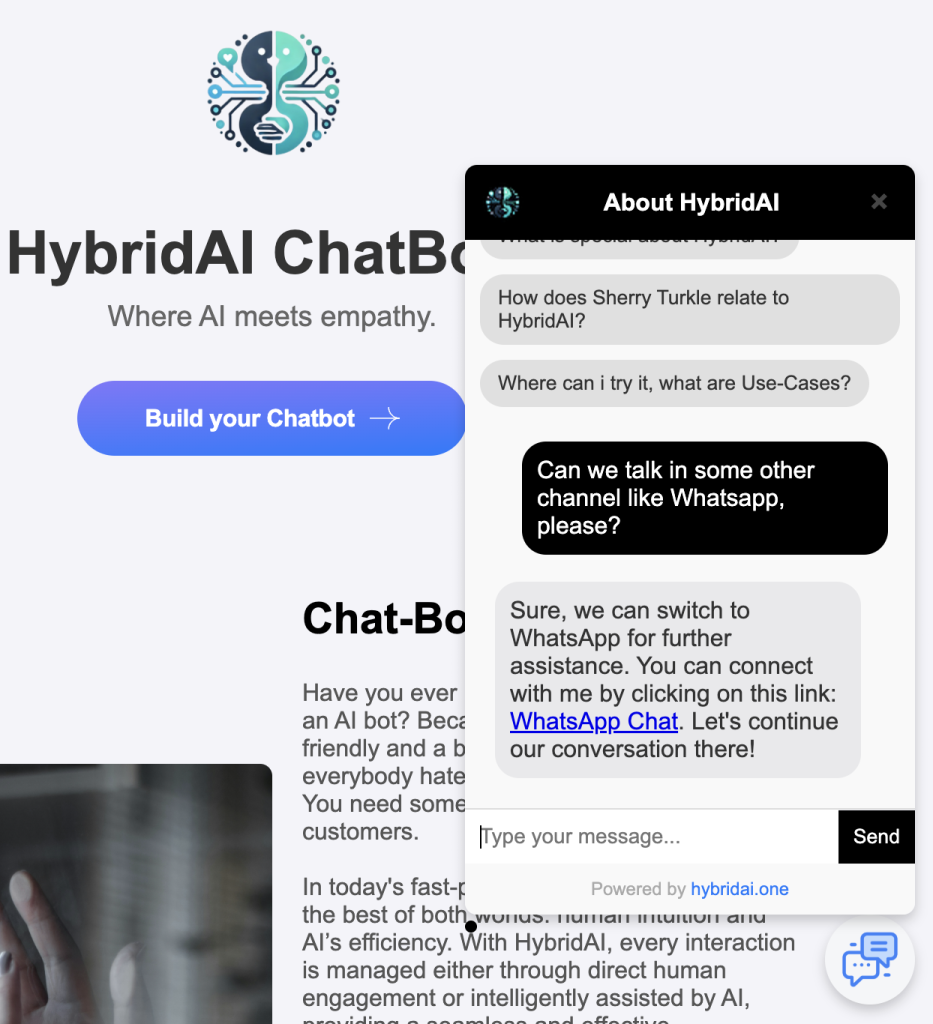
Communication should take place where the user feels most comfortable. A modern chatbot is not only available on the website but also on channels like WhatsApp, Instagram, or Telegram – with the same functionality. This flexibility ensures that users can use the chatbot on their preferred platform without compromising performance.
In 2025 Users expect that they can communicate in the Channel/Tool that they like most.
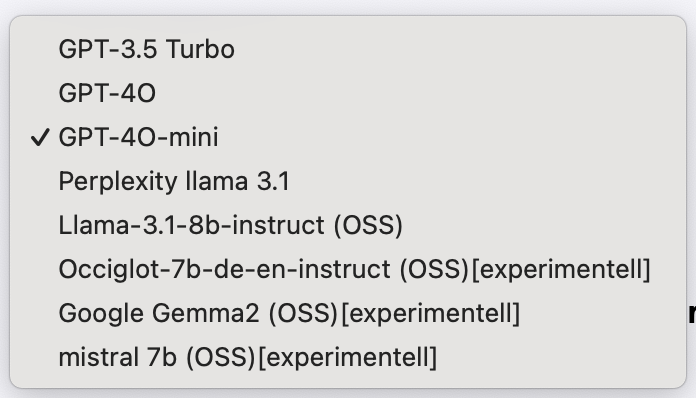
7. Configuration with Different LLM Models
As AI models continuously evolve, a chatbot should be configurable with various large language models (LLMs). This allows businesses to benefit from advancements in AI technology or, if needed, use European AI models to meet data protection requirements and regional regulations.
Different LLM Models for Choice.
Conclusion
The demands on chatbots in 2025 are higher than ever. From smart navigation via deeplinks to multichannel functionality and the use of the latest AI technologies – a high-performing chatbot offers far more than just simple answers to standard questions. Companies that focus on these seven features can ensure they not only meet user expectations but are also future-proof.
In today’s digital world, chatbots are not just useful but often indispensable. Companies and individuals alike benefit from the ability to answer questions quickly and efficiently, enable personal interactions, and automate tasks.
We take a look at the seven best AI chatbots shaping the market in 2025.
HybridAI stands out with its unique combination of emotional understanding and human takeover. Unlike other bots, HybridAI detects emotional triggers and can involve a human operator to handle complex or sensitive issues. It supports multiple AI models like OpenAI, LLaMA, and Gemini, offering tremendous versatility. Additionally, HybridAI can integrate with the advanced European AI models Teuken and Occiglot, a decisive advantage for certain applications.
Strengths:
Emotion-aware and human takeover
Supports multiple AI models
Privacy-friendly and open-source
Function calls and social media integration
Weaknesses:
Limited enterprise integration and team support
Conclusion: For those looking for cutting-edge AI features and a chat communication system where humans intervene when it matters most, HybridAI is unparalleled.
ChatGPT by OpenAI remains a giant in the AI space. It impresses with its naturally sounding responses and extensive language capabilities. However, it is limited to the OpenAI model, which can lead to constraints for specific requirements.
Strengths:
Outstanding language capabilities
Widely adopted and proven
Cutting-edge AI technology
Weaknesses:
No human takeover or advanced emotion detection
Limited customization options
Not suitable for website embedding
Conclusion: Ideal for simple to moderately complex tasks that require fast and precise answers.
UserLike has established itself as a strong partner for customer support. It combines AI-driven responses with the ability to transfer conversations to a human agent.
Strengths:
Seamless integration with existing support systems
Customizable bot personality
User-friendly interface for service teams
Weaknesses:
Limited capabilities compared to specialized AI models
Narrow selection of AI models
Conclusion: A solid choice for companies primarily focused on customer support with a well-established solution where the latest AI features are not a priority.
ChatBase offers advanced training capabilities and excels with its versatility. It’s particularly appealing for companies that need a highly customized chatbot.
Strengths:
Extensive customization and training options
Integration with multiple models
Supports function calls (though not fully flexible)
Weaknesses:
No human takeover
Privacy standards could be higher
Interface language limited to English
Conclusion: Perfect for specific and complex requirements.
Intercom is known for its seamless integration into enterprise environments and CRM systems. It supports high-level customer support but lags behind in AI capabilities.
Strengths:
Excellent integration with enterprise software
Focused on enterprise clients
Weaknesses:
Limited AI functionality
No emotion detection
Complex integration
Conclusion: An excellent choice for large enterprises with specific integration requirements.
MoinAI specializes in email and chat marketing automation, offering AI-powered solutions for customer interactions. It’s especially popular among small and medium-sized businesses.
Strengths:
Automation of repetitive tasks
High user-friendliness
Weaknesses:
Limited adaptability for complex scenarios
AI integration somewhat underdeveloped
High cost
Conclusion: An excellent choice for companies looking to optimize marketing and customer interaction. However, it may not be the best option for those focused on cutting-edge AI functionalities.
IBM Watson Assistant excels with its enterprise features and seamless integration into various platforms. Its powerful AI algorithms and customization options make it a top choice for large enterprises.
Strengths:
Excellent scalability
Extensive integration options
Well-suited for high-governance environments
Weaknesses:
Higher costs compared to other bots
Difficult-to-use knowledge upload functionality
Limited AI model selection
Conclusion: Ideal for enterprises seeking a highly customizable and scalable AI bot.
Conclusion
Choosing the right chatbot depends heavily on individual requirements. HybridAI stands out for its emotional intelligence and privacy features, while ChatGPT shines with its language skills. Companies focused on customer support should consider UserLike or Intercom, while ChatBase excels with its training capabilities. MoinAI offers a specialized solution for marketing and customer communication, while IBM Watson Assistant impresses with enterprise features and scalability.
In 2025, there is more choice than ever, and the perfect solution awaits your needs.
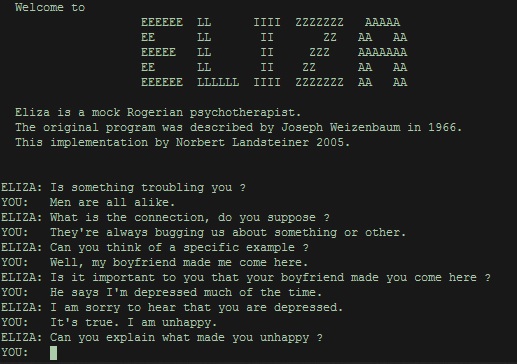
The history of electronic chat systems began in the 1960s when Joseph Weizenbaum, a pioneer in computer science, developed ELIZA. This simple program simulated a psychotherapist by paraphrasing user input. Despite its limited functionality, ELIZA captivated its users profoundly. Many people felt understood—a reaction Weizenbaum himself found alarming. This early experience demonstrated how deeply the human desire for empathy and emotional connection can be triggered, even by rudimentary technology.
Try Eliza yourself! With HybridAI, we’ve recreated this famous (but admittedly quite annoying) first chat system: Chat with Eliza
Joseph Weizenbaum and the Limits of Technology
Weizenbaum initially developed ELIZA as a tool to demonstrate artificial intelligence but was so disturbed by the users’ reactions that he later became a critic of the technology. In his book “Computer Power and Human Reason” (1976), he warned that humans tend to attribute human characteristics to machines and emphasized that technology could never replicate the depth and complexity of human empathy. For Weizenbaum, it was clear: technology alone cannot establish genuine interpersonal relationships.
Sherry Turkle: Putting People at the Center of the Digital Revolution
Psychologist and sociologist Sherry Turkle expanded on Weizenbaum’s critical insights by exploring how humans connect with technology in the digital age. In her books, such as “Reclaiming Conversation” and “Alone Together”, Turkle argues that while technology facilitates communication, it often comes at the expense of genuine emotional closeness. She advocates for a more mindful use of technology, with people placed at the center. “We don’t need more technology—we need more humanity in technology,” is one of her core messages.
The Weakness of Today’s AI Hype
The current hype around AI and chatbots has delivered impressive advancements, but one key question often remains unanswered: Can technology truly win hearts? No matter how sophisticated an AI model may be, communication ultimately boils down to convincing people, making them happy, or winning them over for a cause. This is where many modern AI systems fall short: they can process data, recognize contexts, and generate responses, but they do not truly understand.
Empathy, as humans experience it, is more than a reaction to input—it is the result of genuine listening, compassion, and a desire to build a connection. This connection is often absent in purely AI-driven systems. The focus on efficiency and automation frequently overlooks the fact that trust and satisfaction are not solely created by “perfect” answers but by the feeling of being heard, valued, or even surprised by a witty or unexpected comment.
The Importance of Empathetic Communication
The early work of Weizenbaum and Turkle teaches us that empathy and emotional intelligence are irreplaceable. While technology can help us communicate faster and share information more efficiently, humans remain the key to true persuasive power. Hybrid solutions—like those from HybridAI—aim to bridge this gap by combining the strengths of AI with human interaction. They demonstrate that technology should not be seen as a replacement but as a tool to help people deliver their messages with warmth and empathy.
Conclusion
As technological development continues to advance, we must not forget that communication is fundamentally a human process. The lessons of Weizenbaum and Turkle remind us that empathy is not a “feature” but a mindset. No matter how powerful our technologies become, humans remain the benchmark for meaningful communication—yesterday, today, and in the future.
In a world where artificial intelligence (AI) is increasingly used in customer service, HybridAI stands out with a revolutionary approach. This innovative system combines the efficiency of modern AI technology with the emotional intelligence of human interaction to create a unique chat experience.
The Problem with Traditional AI Chatbots
Many existing AI chatbots fail to address the individual needs of users. Often, their responses are generic, shallow, or even inappropriate. This leads companies to lose potential customers or fail to make a lasting impression. Another issue is the hallucination of AI models, which can generate false or unsuitable information. Increasing restrictions imposed by AI providers exacerbate the situation—particularly US-based models now focus more on being non-offensive than on being relevant. This often undermines meaningful customer interaction and relationship-building.
The HybridAI Solution
HybridAI tackles this problem head-on by combining the strengths of AI and human interaction:
Autonomous AI with Human Backup Option: While the AI works efficiently and autonomously, a human can step in anytime for complex or sensitive topics. A dedicated AI model monitors the conversation and proactively requests human support when needed.
Adaptability: The system can easily be tailored to specific business needs, from custom API integrations to personalized bot identities. Cutting-edge mechanisms such as PDF uploads, website crawling, and function calls are fully supported.
Second AI Model for Better Oversight: Another AI model helps identify problematic content and supports human responses, reducing the workload of chat teams while ensuring they’re involved in critical interactions.
What Makes HybridAI Unique?
Emotional Sensitivity: As the only system on the market, HybridAI detects emotional stress situations or critical moments—such as just before a purchase—and hands over to a human agent.
Combination of AI Models: The system uses the best available models and integrates special functions like API queries.
GDPR Compliance: By supporting local and open-source AI models, HybridAI ensures complete data sovereignty and security.
With this approach, HybridAI not only revolutionizes customer service but also sets new standards for empathy and efficiency in the digital age. Companies looking to elevate their customer service should explore this groundbreaking system.
To provide the best experiences, we use technologies like cookies to store and/or access device information. Consenting to these technologies will allow us to process data such as browsing behavior or unique IDs on this site. Not consenting or withdrawing consent, may adversely affect certain features and functions.
Functional
Always active
The technical storage or access is strictly necessary for the legitimate purpose of enabling the use of a specific service explicitly requested by the subscriber or user, or for the sole purpose of carrying out the transmission of a communication over an electronic communications network.
Preferences
The technical storage or access is necessary for the legitimate purpose of storing preferences that are not requested by the subscriber or user.
Statistics
The technical storage or access that is used exclusively for statistical purposes.The technical storage or access that is used exclusively for anonymous statistical purposes. Without a subpoena, voluntary compliance on the part of your Internet Service Provider, or additional records from a third party, information stored or retrieved for this purpose alone cannot usually be used to identify you.
Marketing
The technical storage or access is required to create user profiles to send advertising, or to track the user on a website or across several websites for similar marketing purposes.